
Anúncios
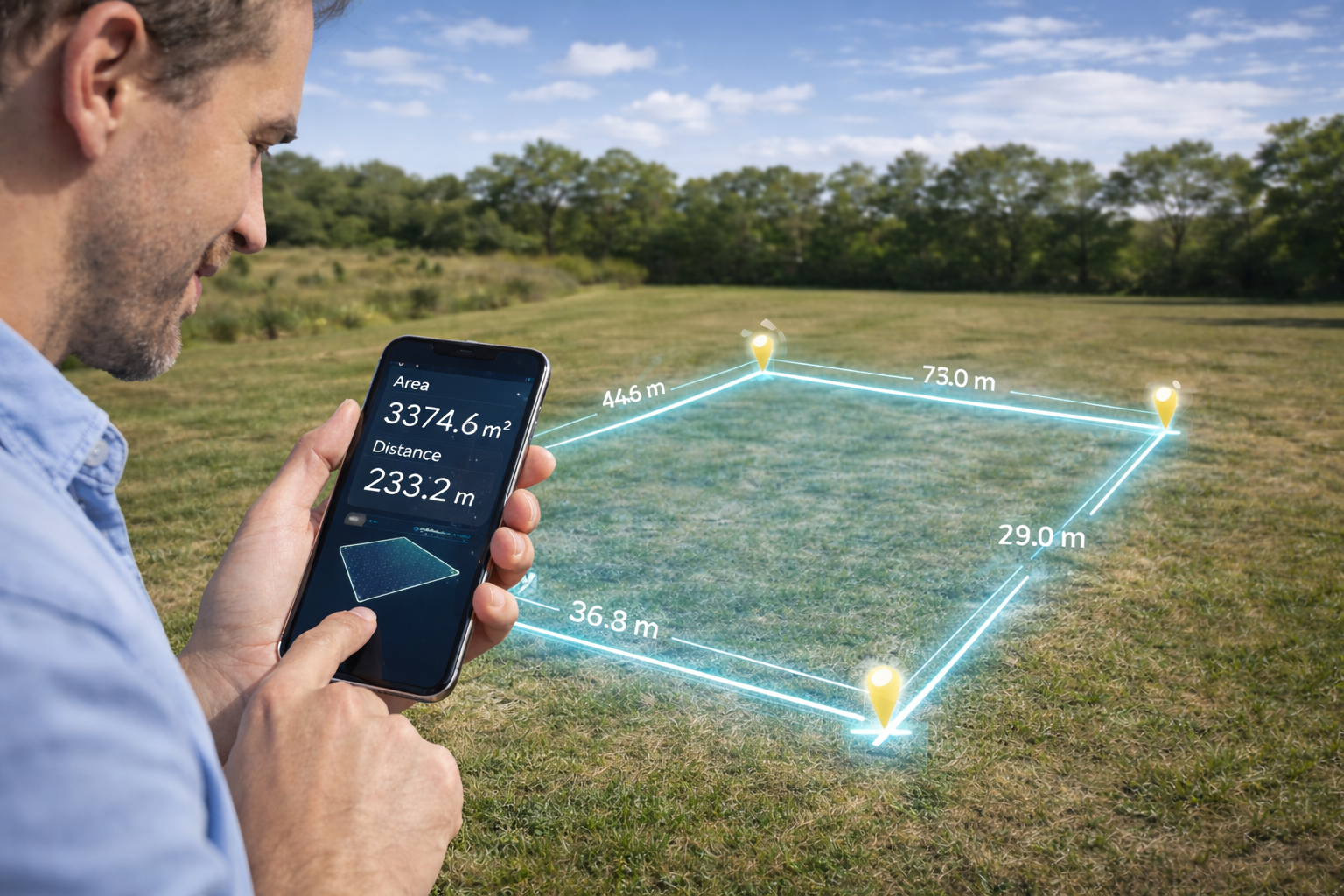
Measuring land and properties has never been easier. With mobile apps, you can now measure areas and terrains in seconds, directly from your smartphone—no bulky equipment needed. 📱


Gone are the days when measuring land required expensive tools, professional surveyors, or complex calculations. Today, technology has democratized the process, putting powerful measurement capabilities right in your pocket. Whether you’re a real estate professional, farmer, construction worker, or simply someone who needs to measure a backyard, mobile land measurement apps have revolutionized how we approach spatial calculations.
These innovative applications leverage GPS technology and satellite mapping to deliver accurate area measurements with remarkable precision. The best part? You don’t need any technical expertise or specialized training. Simply walk around the perimeter of your property with your smartphone, and the app does all the heavy lifting for you.
🌍 Why Traditional Land Measurement Methods Are Becoming Obsolete
Traditional land surveying has served us well for centuries, but it comes with significant limitations that modern technology has effectively addressed.
Conventional measurement methods typically require professional surveyors who use theodolites, total stations, and other expensive equipment. These services can cost hundreds or even thousands of dollars, depending on the property size and location. For someone who simply needs a quick measurement for planning purposes, this expense is often prohibitive.
Time is another critical factor. Scheduling a professional surveyor, waiting for their availability, and then waiting for results can take days or even weeks. In contrast, a mobile measurement app delivers instant results the moment you complete walking the perimeter.
Accessibility also plays a crucial role. Not everyone lives near professional surveying services, especially in rural or remote areas. Mobile apps eliminate geographical barriers, making measurement capabilities available to anyone with a smartphone and GPS signal.
📲 How Land Measurement Apps Actually Work
The technology behind these applications is sophisticated yet remarkably user-friendly. Understanding the mechanics helps you appreciate their accuracy and reliability.
Most land measurement apps utilize GPS (Global Positioning System) technology combined with satellite imagery. When you open the app and begin walking around your property, the GPS receiver in your phone tracks your exact coordinates at multiple points along your path.
The application connects these coordinate points to create a polygon representing your land area. Using geometric calculations, it then computes the total area enclosed within that polygon. Advanced apps apply correction algorithms to account for GPS drift and signal variations, ensuring measurements remain accurate within acceptable margins.
Some premium applications also integrate satellite imagery from services like Google Maps or other mapping platforms. This allows you to manually trace property boundaries on a map if physically walking the perimeter isn’t practical or possible.
🎯 GPS Accuracy: What to Expect
Consumer-grade GPS in smartphones typically offers accuracy between 3 to 10 meters under ideal conditions. While this might seem imprecise for critical legal purposes, it’s more than sufficient for most practical applications like:
- Estimating property sizes before purchase
- Planning garden layouts and landscaping projects
- Calculating fertilizer or seed requirements for agricultural land
- Determining fencing materials needed
- Estimating construction areas and material quantities
- Assessing land for development potential
For legal documentation and official property registration, professional surveying remains necessary. However, for preliminary assessments and everyday calculations, mobile apps provide excellent accuracy at a fraction of the cost.
✨ Key Features That Make These Apps Indispensable
Modern land measurement applications pack impressive functionality into intuitive interfaces. Here are the standout features that transform your smartphone into a powerful surveying tool.
📍 GPS-Based Perimeter Tracking
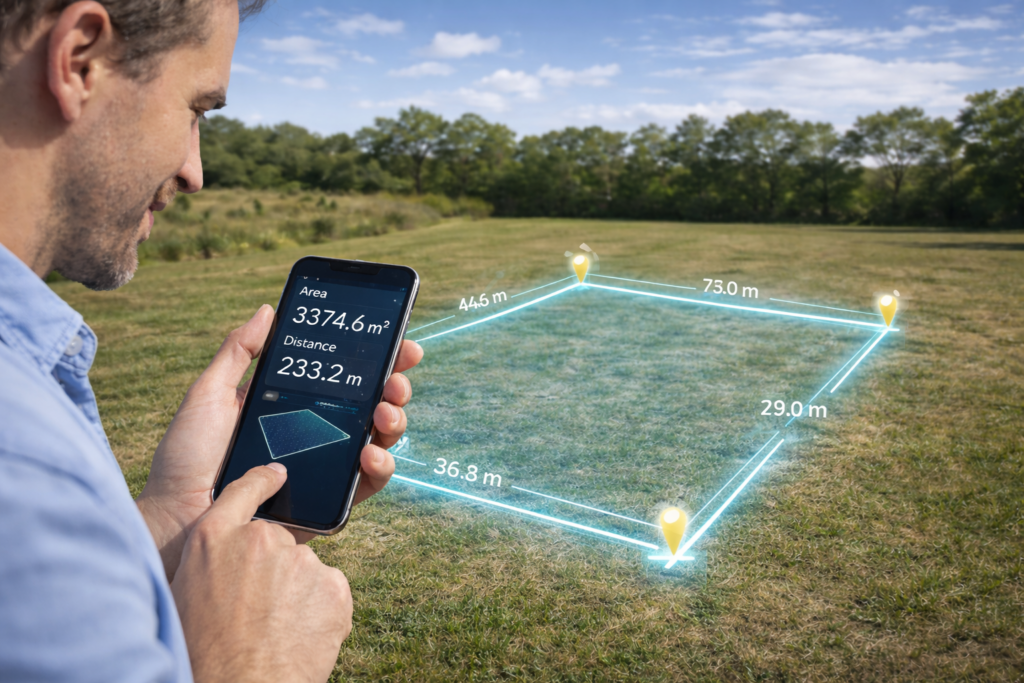
The cornerstone feature allows you to walk around any area while the app automatically records GPS coordinates. Simply tap to start, walk the boundary, and tap again to complete the measurement. The app instantly calculates the total area.
🗺️ Manual Map Measurement
Can’t physically access the property? Many apps let you measure areas directly on satellite maps. Zoom into your location, tap points around the perimeter, and receive instant calculations. This feature is particularly valuable for comparing multiple properties or measuring distant locations.
📐 Multiple Unit Support
Professional apps support various measurement units to accommodate different regions and preferences:
- Square meters (m²)
- Square feet (ft²)
- Acres
- Hectares
- Square yards
- Square kilometers
Unit conversion happens automatically, letting you switch between measurements with a single tap.
💾 Save and Export Measurements
Quality apps allow you to save unlimited measurements with custom names and notes. Export options typically include PDF reports, image files, or coordinate data that you can share via email or messaging apps.
📊 Distance and Perimeter Calculation
Beyond area measurement, these apps calculate total perimeter length and distances between specific points. This helps when planning fencing, irrigation systems, or pathways.

🏡 Real-World Applications That Save Time and Money
The practical applications of land measurement apps extend across numerous industries and personal scenarios. Let’s explore how different users benefit from this technology.
🌾 Agriculture and Farming
Farmers use these apps daily to measure field sizes for crop planning, calculate seed and fertilizer requirements, and manage irrigation systems. Accurate area measurements help optimize resource allocation and improve yield predictions. Instead of guessing or using outdated measurements, farmers get real-time data that directly impacts profitability.
🏗️ Construction and Development
Construction professionals rely on measurement apps for preliminary site assessments, material estimations, and project planning. Before committing to detailed surveying, they can quickly evaluate multiple sites and make informed decisions about feasibility and costs.
🏠 Real Estate and Property Management
Real estate agents and property managers use these tools to verify property sizes, create accurate listings, and provide clients with immediate information during site visits. The ability to measure properties on-the-spot enhances credibility and accelerates sales processes.
🌳 Landscaping and Garden Planning
Homeowners and landscaping professionals measure yards, gardens, and outdoor spaces to plan layouts, order materials, and estimate project costs. Whether you’re installing a new lawn, building a patio, or planting a garden, knowing exact measurements prevents wasteful overordering or frustrating shortages.
🚧 Infrastructure and Municipal Planning
Municipal workers and infrastructure planners use measurement apps for preliminary assessments of parks, roads, and public spaces. While official projects require professional surveying, these apps facilitate initial planning and budgeting.
💡 Tips for Getting the Most Accurate Measurements
While measurement apps are remarkably accurate, following best practices ensures you get the most reliable results possible.
🌤️ Choose Optimal Weather Conditions
GPS signals perform best under clear skies. Heavy cloud cover, storms, or dense fog can interfere with satellite reception and reduce accuracy. Schedule your measurements for clear days when possible.
🏞️ Avoid Obstructed Areas
Tall buildings, dense forests, and steep valleys can block GPS signals or cause multipath interference where signals bounce off surfaces before reaching your phone. When measuring such areas, walk the perimeter slowly and allow the app extra time to acquire strong signals.
🔋 Ensure Full Battery Charge
GPS tracking is battery-intensive. Start measurements with a fully charged phone, or bring a portable charger for large properties. An unexpected battery death mid-measurement means starting over.
👟 Walk Steadily Along Boundaries
Maintain a steady, moderate pace while walking the perimeter. Moving too quickly can cause the app to miss turns or create irregular polygon shapes. Pause briefly at corners to ensure the app registers direction changes.
🔄 Take Multiple Measurements
For important measurements, walk the perimeter multiple times and average the results. This reduces errors from GPS drift and improves overall accuracy.
📱 Keep Your Phone Level
Hold your smartphone at a consistent height, ideally chest-level, while walking. This maintains consistent GPS reception and prevents measurement variations.
🆚 Comparing Top Land Measurement Apps
While many apps offer land measurement capabilities, certain features distinguish professional-grade tools from basic alternatives.
The best apps combine GPS accuracy with satellite imagery integration, allowing both physical and map-based measurements. They offer offline functionality so you can measure remote properties without internet connectivity, syncing data once you return to coverage.
User interface design matters significantly. Intuitive apps require minimal learning curves, with clear visual indicators, simple controls, and helpful tutorials. Complex interfaces frustrate users and increase measurement errors.
Data management capabilities separate good apps from great ones. Look for unlimited save slots, organized project folders, custom naming options, and multiple export formats. The ability to annotate measurements with photos and notes adds tremendous value for documentation purposes.
Customer support and regular updates indicate developer commitment to quality. Apps that receive frequent improvements, bug fixes, and feature additions demonstrate ongoing investment in user experience.
🔒 Privacy and Data Security Considerations
When using location-based apps, understanding privacy implications helps you make informed decisions about data sharing.
Reputable measurement apps typically store data locally on your device unless you explicitly choose cloud backup options. Review app permissions carefully before installation, granting only necessary access to GPS, storage, and camera functions.
Read privacy policies to understand how developers handle location data. Premium apps from established companies generally maintain stricter privacy standards than free alternatives that may monetize user data through advertising or third-party sales.
For sensitive properties or confidential projects, consider apps that offer offline-only operation with no data transmission requirements. This ensures your measurements remain completely private.
💰 Free vs. Premium: Which Option Suits Your Needs?
Land measurement apps range from completely free to premium subscriptions. Understanding the differences helps you choose appropriately.
Free versions typically include basic measurement functionality with limitations like maximum saved projects, reduced accuracy algorithms, or advertisement interruptions. They work well for occasional users with simple needs.
Premium versions remove restrictions and add advanced features like unlimited measurements, higher precision calculations, professional reporting formats, customer support, and ad-free experiences. For professionals or frequent users, the investment quickly pays for itself through time savings and enhanced capabilities.
Some apps offer hybrid models with free core functionality and optional in-app purchases for specific advanced features. This approach lets you test basic capabilities before committing to paid upgrades.
🚀 The Future of Mobile Land Measurement Technology
Emerging technologies promise even greater accuracy and functionality for mobile measurement applications.
Augmented reality (AR) integration is beginning to appear in advanced apps, overlaying measurement data directly onto your camera view as you scan property boundaries. This creates intuitive visual representations that simplify complex measurements.
Improved satellite networks, including newer GPS satellites and competing systems like Galileo and GLONASS, continually enhance positioning accuracy. Future smartphones will leverage these multiple systems simultaneously for centimeter-level precision.
Artificial intelligence and machine learning algorithms are being developed to automatically detect property boundaries from satellite imagery, reducing manual input requirements. These systems will recognize fences, property lines, and natural boundaries with minimal user intervention.
Integration with drone technology represents another exciting frontier. Some apps already allow importing drone-captured coordinates for measurements in areas difficult to access on foot.
🎓 Learning Curve and Getting Started
One of the greatest advantages of modern measurement apps is their minimal learning curve. Most users begin measuring properties accurately within minutes of installation.
After downloading and opening the app, you’ll typically find a tutorial or quick-start guide explaining basic functions. Take a few minutes to review this information—it prevents common beginner mistakes and accelerates proficiency.
Practice on familiar areas first. Measure your backyard, driveway, or local park before tackling important projects. This builds confidence and helps you understand how GPS accuracy varies in different environments.
Explore all features systematically. Many users stick with basic functions without discovering time-saving advanced capabilities. Spend time clicking through menus and settings to understand the full range of available tools.
Join user communities or forums where experienced users share tips, troubleshooting advice, and creative applications. These communities often reveal hidden features or workflows that aren’t immediately obvious.
🌟 Why Now Is the Perfect Time to Start Using Measurement Apps
The convergence of affordable smartphones, accurate GPS technology, and sophisticated software has created an ideal environment for mobile land measurement.
Smartphones have become ubiquitous, meaning most people already own the necessary hardware. No additional equipment purchases are required—just download an app and start measuring.
GPS accuracy has improved dramatically over the past decade. Modern smartphones include advanced GPS chips that deliver positioning accuracy once available only in professional equipment costing thousands of dollars.
App development has matured, with experienced developers creating polished, reliable applications backed by regular updates and customer support. Early measurement apps were often buggy and unreliable; today’s options are professional-grade tools.
The cost barrier has essentially disappeared. Even premium apps cost less than a single hour of professional surveying services, making them accessible to virtually everyone.
🔧 Troubleshooting Common Measurement Issues
Even with user-friendly apps, occasional challenges arise. Understanding common problems and solutions ensures consistent results.
If measurements seem inaccurate, first check GPS signal strength. Most apps display signal indicators—wait for strong signals before beginning measurements. Moving to open areas away from buildings and trees often resolves reception issues.
Inconsistent results from repeated measurements suggest GPS drift. This natural GPS variation means coordinates fluctuate slightly even when standing still. Taking multiple measurements and averaging results compensates for this phenomenon.
App crashes or freezing typically indicate software conflicts or insufficient device resources. Close background apps, restart your phone, and ensure you’re running the latest app version with current operating system updates.
Saved measurements that won’t export often relate to storage permissions. Check app settings to ensure necessary permissions are granted for file creation and sharing.
Battery drain during measurements is normal due to constant GPS usage. Enable battery-saving modes if available within the app, or carry portable chargers for extended measurement sessions.
🎯 Making the Switch: Your Measurement Revolution Starts Today
The transition from traditional to mobile measurement methods represents more than technological advancement—it’s a fundamental shift in accessibility and empowerment.
Property measurement was once the exclusive domain of trained professionals with expensive equipment. Today, anyone can measure land areas with accuracy sufficient for most practical purposes, using nothing more than a smartphone and free or inexpensive app.
This democratization benefits everyone from professional farmers managing hundreds of acres to homeowners planning backyard projects. The time savings alone justify adoption, but the cost reduction and convenience make mobile measurement apps indispensable tools for the modern age.
Whether you’re evaluating properties for purchase, planning agricultural activities, estimating construction materials, or simply satisfying curiosity about land sizes, measurement apps deliver immediate, accurate results without the hassle and expense of traditional methods.
The technology has proven itself reliable across millions of measurements worldwide. Early adopters have already discovered how these tools simplify tasks that once required professional assistance. Now it’s your turn to experience the convenience and power of instant land measurement.
Download a measurement app today and discover how effortlessly you can measure areas and properties. Within minutes, you’ll wonder how you ever managed without this capability in your pocket. The future of land measurement isn’t coming—it’s already here, waiting in your smartphone. 🌍📱
